Fair Play: Exploring Play, Accessibility and Representation Towards a Framework for Fairness in Digital Games
jun. 25, 2026· ,,·
0 minutos de leitura
,,·
0 minutos de leitura
Virgíia Fernandes Mota
Camila Laranjeira
Thaís Steinmüller
Emanuel Felipe Duarte
Resumo
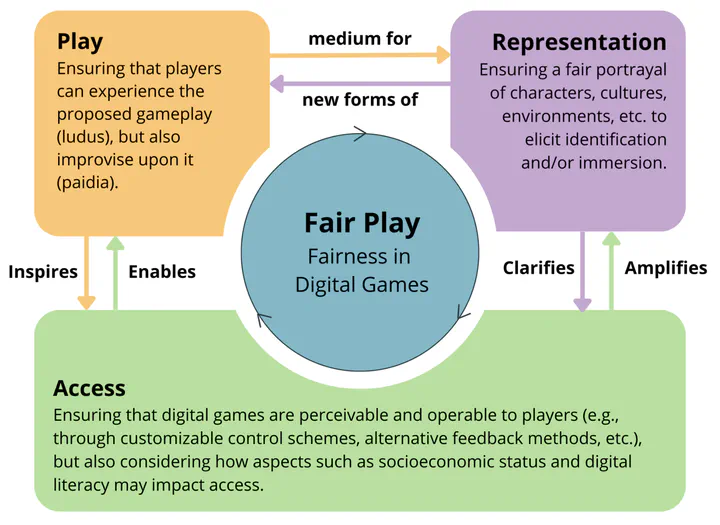
Play is essential to culture and social life. Digital games - a contemporary form of play - have increasingly become a focus of research aimed at fostering inclusive and equitable player experiences, particularly through accessibility mechanisms for people with disabilities and through the portrayal of marginalized communities (e.g., women, disabled players, and culturally diverse communities). Problem - Despite advances in game accessibility, many approaches still frame inclusion mainly as a technical challenge, overlooking its social, cultural, and ethical dimensions. At the same time, marginalized groups remain underrepresented or stereotyped in games and their narratives. Method - Grounded in socioenactive and phenomenological perspectives, we introduce the Fair Play framework, proposing a unifying concept of fairness for digital games that articulates accessibility, representation, and the essence of play as interdependent dimensions. Additionally, we propose the Fair Play Cards to operationalize these concepts within the three phases of game design-ideation, development, and evaluation. The cards include actionable prompts to foster discussion and suggest the production of technical artifacts that bridge critical theory and design practice. Lastly, we demonstrate a practical application of our framework through the development of a game prototype entitled Romaria. Discussion - We argue that our framework reframes Fair Play as a situated, embodied, and plural design commitment, offering practical guidance for creating games that are not only accessible and representative, but also fair in how play itself is experienced.
Tipo
Publicação
In 2026 ACM Conference on Fairness, Accountability, and Transparency